
If you have visited more than one preschool recently, you have almost certainly heard the phrase play-based learning. Every school uses it. Almost every brochure features it. And if you are like most parents, you have probably wondered: is this a genuine educational approach — or is it just a nicer way of saying the children play while the teachers watch?
It is a fair question. And the answer matters — because the difference between genuine play-based learning and superficial activity time is the difference between a child who develops deep cognitive, emotional and social foundations and one who simply passes the time pleasantly until primary school.
Here is what play-based learning actually is, why the evidence behind it is stronger than most people realise and — crucially — how to tell whether a school is genuinely delivering it.
The Short Answer
Play-based learning is a structured approach to early childhood education in which carefully designed play activities are the primary vehicle for cognitive, social, emotional and physical development. It is not unstructured free time. It is intentional — teachers plan the environment, the materials and the interactions to ensure specific developmental goals are met through a child's natural drive to explore and create.
The evidence for its effectiveness is substantial: children who experience high-quality play-based learning in their early years demonstrate stronger problem-solving skills, better emotional regulation, richer language development and — perhaps most importantly — a more durable love of learning than children educated through early academic instruction alone.
What Play-Based Learning Actually Is
Play-based learning sits at the intersection of what children naturally do and what educators intentionally design.
A child sorting coloured blocks is developing early mathematical reasoning. A child negotiating roles in a pretend-play scenario is developing language, social skills and emotional intelligence simultaneously. A child mixing colours at a painting table is developing fine motor skills, sensory awareness and creative thinking — often without realising they are learning anything at all.
The teacher's role in play-based learning is not passive. It is the opposite. Teachers design the environment, introduce carefully chosen materials, observe closely, ask open-ended questions and intervene with purpose — guiding without directing, extending without limiting.
What It Is Not
- Unstructured free time with no developmental intention behind it
- Children doing whatever they want while teachers manage the room
- The absence of learning goals — it simply pursues those goals differently
- Applicable only to very young children — its principles extend meaningfully through primary years
The confusion between genuine play-based learning and activity-based childcare is the reason some parents are sceptical of the term. That scepticism is appropriate when directed at schools that use the label without the substance. It is not appropriate as a critique of the approach itself.
The Real Benefits — What Research Tells Us
The evidence base for play-based learning in early childhood is extensive and consistent across decades of developmental research. Here are the six most significant and well-documented benefits.
1. Cognitive Development and Problem-Solving
Play is the primary context in which young children develop their capacity to think. When a child builds a structure, figures out why it falls and tries a different approach, they are practising the core cognitive loop — hypothesis, test, evaluate, revise — that underpins all higher-order thinking.
Studies in early childhood neuroscience consistently show that children who learn through structured play develop stronger executive function — the cognitive system responsible for planning, focus, mental flexibility and impulse control — than children in academically pressured early environments.
2. Language and Communication
Play is extraordinarily language-rich. Pretend play, storytelling, negotiating roles, asking questions of a teacher, describing what they observe — these activities generate far more varied and complex language exposure than worksheets or structured recitation.
Children in play-based environments typically develop stronger vocabulary, more complex sentence structures and greater narrative ability by the time they reach primary school. These advantages compound significantly over time.
3. Emotional Intelligence and Self-Regulation
Managing emotions — learning to wait, to tolerate frustration, to recover from disappointment — is one of the most valuable things a child can develop in the early years. It is also one of the things that formal academic instruction is worst at building.
Play provides a natural, low-stakes environment in which children encounter and navigate emotional challenges constantly. A game that does not go their way. A peer who will not share. A creation that breaks. These small frustrations, managed within a warm and supportive environment, build the emotional resilience that serves children throughout their lives.
4. Social Skills and Collaboration
Children learn to navigate relationships by being in them. Play-based learning creates the conditions for genuine peer interaction — cooperation, negotiation, conflict resolution and empathy — in a way that individual academic tasks cannot replicate.
The capacity to work with others, read social cues and contribute to a group is not incidental to early childhood education. It is central to it. And play is where this capacity is built.
5. Physical Development and Coordination
Fine motor skills — the hand and finger control needed for writing, drawing and self-care — and gross motor skills — running, climbing, balancing — develop through physical play. A child who has spent their early years actively engaged in hands-on, physical activity arrives at primary school with the physical readiness that formal learning demands.
6. Intrinsic Motivation and Love of Learning
This may be the most consequential benefit of all — and the one most at risk when early childhood education prioritises academic performance over genuine engagement.
Children who are pushed toward formal learning before they are developmentally ready frequently develop anxiety around school, avoidance of challenge and a performance orientation — doing things to please adults rather than out of genuine interest. Children who learn through play in their early years typically carry into primary school something far more valuable: the belief that learning is inherently interesting and that trying things — even things they might get wrong — is worth doing.
That belief, established in the preschool years, is one of the strongest predictors of long-term academic and personal success.
Why Play-Based Learning Prepares Children for the Future
The skills that the future demands are precisely the skills that play-based learning builds best.
Automation and artificial intelligence are reshaping the labour market in ways that make the memorisation of information — once the cornerstone of academic success — increasingly irrelevant. What remains irreplaceable is human capacity: creativity, critical thinking, emotional intelligence, collaboration and adaptability.
These are not skills that can be drilled. They are capacities that develop through experience — through the kind of exploratory, social, imaginative activity that play-based learning deliberately cultivates.
A child who spent their preschool years building structures that fell and trying again, negotiating with peers, creating stories, asking questions and discovering that the world responds to curiosity is a child who is more prepared for an uncertain future than one who can write their alphabet at age 3 but has never been allowed to follow their own interest for more than five minutes.
The preschool years are not a rehearsal for real education. They are the foundation of it. And play-based learning is the approach that takes that foundation seriously.
Genuine Play-Based Learning vs Performative Play-Based Learning
This is the part most articles skip entirely — and the part every parent evaluating schools in Rohini needs most.
The term "play-based learning" has become so widely used in school marketing that it no longer carries reliable meaning on its own. A school can describe its programme as play-based while running a classroom that looks remarkably like a structured academic session — worksheets, formal instruction and children seated in rows.
The difference is observable. Here is how to see it.
How to Tell the Difference — What to Look for in a Classroom
In a genuinely play-based classroom, you will see:
- Children choosing their own activities within a prepared, intentional environment
- Multiple different activities happening simultaneously — not all children doing the same thing
- Teachers observing, asking open-ended questions and extending play — not directing from the front
- A range of materials: sensory trays, building blocks, art supplies, dramatic play props, books and puzzles
- Noise — purposeful, engaged noise — not silence enforced through instruction
- Children who appear absorbed, curious and self-directed
In a classroom that only claims play-based learning, you may see:
- All children doing the same activity at the same time
- Teacher-directed tasks with a single correct outcome
- Worksheets or structured writing activities for children under 4
- Children sitting for extended periods without movement
- Play equipment that exists but is rarely used during the school day
- A heavy emphasis on letters, numbers and academic content from the earliest years
The visit to a school campus before admission is not just about seeing the facilities. It is about observing what is actually happening in the classroom when you walk in — and knowing what genuine learning looks like when you see it.
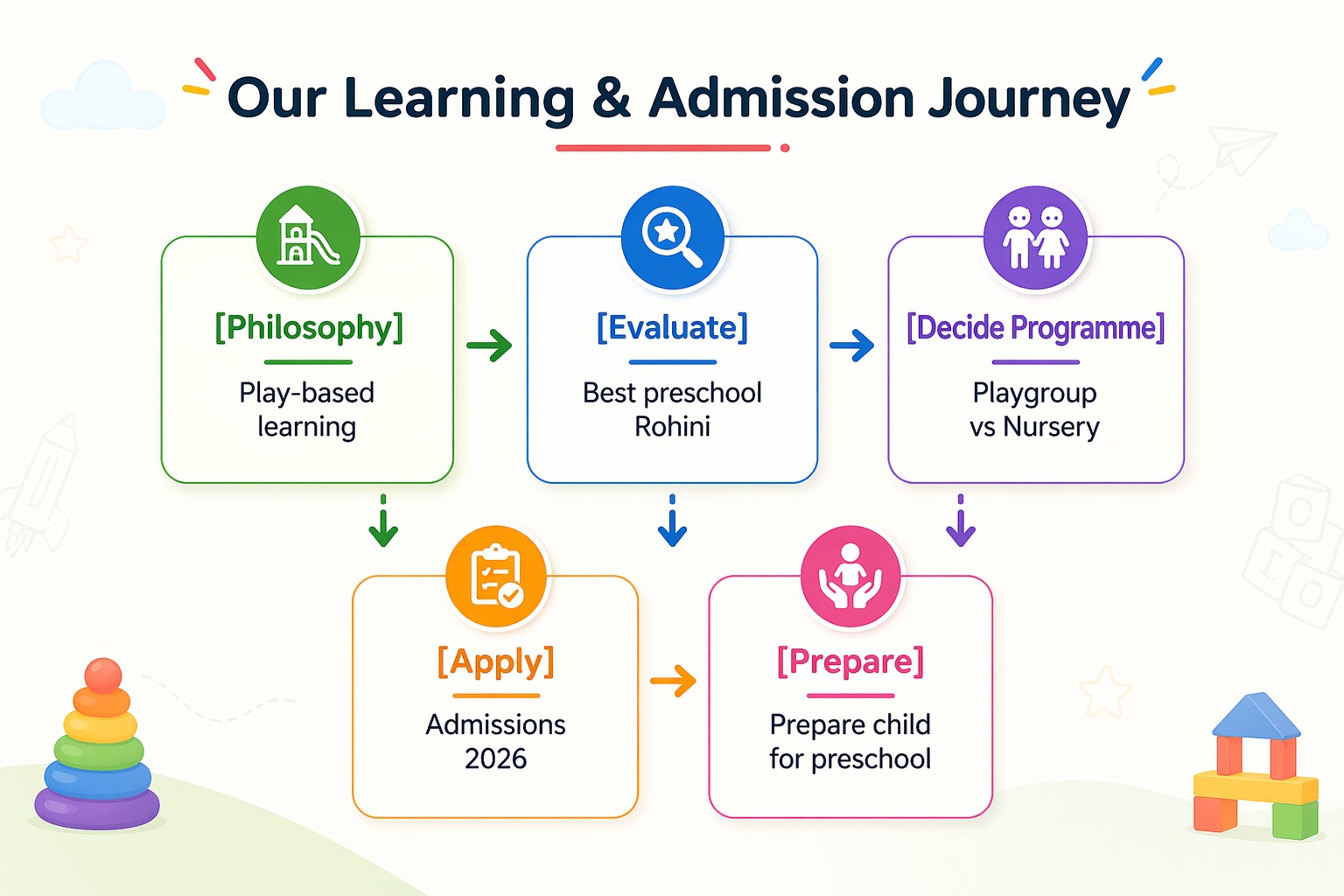
For a complete framework on what to look for, what questions to ask and which red flags to watch for during any preschool visit in Rohini, the best preschool in Rohini guide covers this in detail.
What Parents Should Ask Any School About Play-Based Learning
- "Can you walk me through what a typical morning looks like for a 3-year-old in your class?"
- "How do teachers decide what activities to offer each day?"
- "How do you balance play with learning goals?"
- "How do you track development — what does your assessment process look like?"
- "What is the teacher-to-child ratio, and how do teachers interact with children during play?"
A school that genuinely delivers play-based learning will answer these questions specifically, enthusiastically and with concrete examples. A school that uses the term as a marketing position will give you vague, reassuring generalities.
If you are in the process of confirming your school choice or are ready to begin the admission process at SHEMROCK Heritage — where play-based, child-centred learning has been at the heart of the programme since 2005 — the admissions page has everything you need to take the next step.
And if your child is between 2 and 3 years old and you are still deciding between playgroup and nursery, understanding which programme level provides the most appropriate play-based environment for your child's specific stage is worth getting right first — the playgroup vs nursery guide covers that decision in detail.
Play-Based Learning Benefits
- Builds stronger problem-solving and critical thinking through exploratory, trial-and-error activity
- Develops richer language and communication through storytelling, pretend play and open-ended conversation
- Builds emotional intelligence and self-regulation through naturally occurring social challenges
- Develops collaboration, empathy and conflict resolution through peer interaction
- Supports fine and gross motor development through hands-on physical activity
- Cultivates intrinsic motivation and a durable love of learning — the strongest predictor of long-term academic success
Play-Based vs Academic Learning in Preschool
| Aspect | Play-Based Learning | Early Academic Instruction |
|---|---|---|
| Primary method | Child-directed exploration | Teacher-directed instruction |
| Learning vehicle | Play, discovery, social interaction | Structured lessons, worksheets |
| Teacher role | Observer, guide, environment designer | Instructor, evaluator |
| Focus | Whole-child development | Academic content |
| Motivation | Intrinsic — curiosity and interest | Extrinsic — performance and reward |
| Long-term outcome | Stronger executive function, love of learning | Risk of performance anxiety if introduced too early |
Frequently Asked Questions
Play-based learning is an early childhood education approach where children develop cognitive, social, emotional and physical skills through carefully planned play activities rather than formal instruction. The learning is real and intentional — it just happens through exploration and discovery rather than lessons and worksheets.
For children aged 2 to 5 years, yes — consistently, according to developmental research. Young children are not neurologically ready for sustained formal instruction. They learn most effectively through active exploration, social interaction and play. Traditional academic instruction introduced too early is associated with increased anxiety and reduced intrinsic motivation, without meaningful academic advantage.
Visit the classroom and observe. In a genuine play-based environment, children choose from a range of activities, multiple things are happening simultaneously, teachers ask open-ended questions rather than directing from the front, and children appear absorbed and self-directed. If all children are doing the same activity at the same time and worksheets are common, the school may use the term without the substance.
No. Play-based learning absolutely develops early literacy and numeracy — through counting games, storytelling, sorting activities, rhymes and language-rich play. The difference is that these skills develop through meaningful, contextual activity rather than formal drilling. The outcomes are the same or better — the experience for the child is significantly different.
Most early childhood development frameworks suggest that a gradual shift toward more structured learning is appropriate from around age 5 to 6 — broadly aligned with the start of primary school. Before this, play-based approaches consistently produce stronger developmental outcomes. Even in primary school, the most effective programmes maintain strong elements of experiential, activity-based learning.
Free play is unstructured — children choose what to do with no adult intention behind the environment or activities. Play-based learning is intentional — teachers design the space, choose the materials and observe purposefully to ensure specific developmental goals are being met. Both have value, but play-based learning is a more structured pedagogical approach.
The skills most valued in a future shaped by AI and automation — creativity, critical thinking, emotional intelligence, collaboration and adaptability — are precisely the skills that play-based learning builds most effectively. Rote memorisation and early academic drilling develop skills that are increasingly automatable. Play-based learning develops the distinctly human capacities that are not.
Related Reading
Ready to visit SHEMROCK Heritage?
Explore how genuine play-based, child-centred learning can help your child build confidence, curiosity and school readiness.