
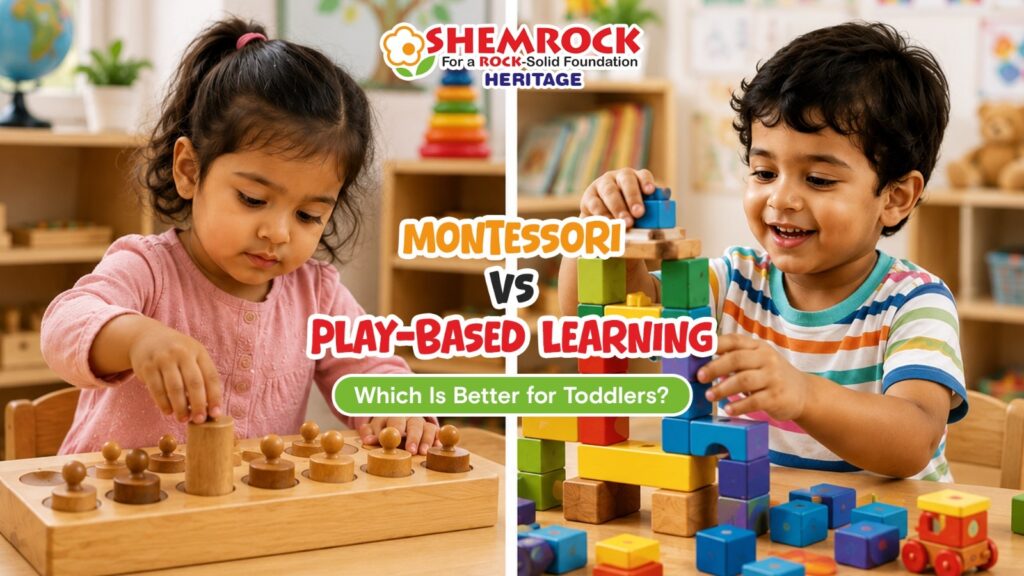
Montessori is a structured, self-directed method built around specific hands-on, self-correcting materials and long independent work periods. Play-based learning uses open-ended, teacher-facilitated play—games, pretend scenarios and group activities—as the main vehicle for learning. Neither is universally “better.” The right fit depends on your child's temperament, attention span and response to structure.
Ask five parents what “Montessori” or “play-based learning” really means day to day, and you'll get five different answers—usually pieced together from social media, brochures and other parents' explanations.
Both methods have decades of research behind them. Both can help a toddler thrive. But they get there differently, and picking blind often means choosing based on marketing rather than on your actual child.
This guide breaks both approaches down properly—including where they come from, what peer-reviewed research says about outcomes and how India's own early-years framework treats play—then shows how Shemrock Heritage blends both into one classroom rhythm instead of forcing a choice.
What Is Montessori Learning?
The Montessori method comes from Dr. Maria Montessori, an Italian physician and educator who developed it over a century ago based on clinical observation of how young children concentrate and learn. Her core belief: children have a natural, internal drive to learn, and the adult's job is to prepare the right environment, not deliver lessons.
A genuine Montessori classroom is organised into five curriculum areas, each with its own set of materials:
Practical Life
Everyday tasks such as pouring, fastening, carrying and tidying that build coordination and independence.
Sensorial
Materials that help children notice, compare and classify qualities such as shape, texture, size and sound.
Language
Hands-on preparation for vocabulary, phonics, writing and reading.
Mathematics
Concrete materials that make quantities, patterns and number relationships visible.
Culture
Early exploration of geography, science, art, music and the wider world.
Montessori materials are typically self-correcting: a child can see whether a puzzle piece fits or a sequence is right without needing a teacher to confirm it. That deliberate design builds independence instead of dependence on adult approval.
Other defining features
- Mixed-age classrooms: Often ages 3–6 learn together, so younger children observe older peers and older children reinforce their understanding by helping.
- Uninterrupted work cycles: Often lasting 2–3 hours, these let a child choose an activity and remain with it while engaged.
- The teacher as guide, not lecturer: Teachers observe closely, introduce a material at the right moment and otherwise step back.
- Freedom within limits: Children choose their activity, but the available choices and the rules of each material are clearly defined.
What Is Play-Based Learning?
Play-based learning starts from a different premise, shaped heavily by developmental psychologists Jean Piaget and Lev Vygotsky. Piaget argued that children construct their understanding of the world through direct experience and experimentation—play is how that experimentation happens. Vygotsky added the social layer: children learn from interacting with peers and adults, often reaching a little further with guidance than they could alone.
In practice, a play-based classroom looks livelier and more improvisational than a Montessori one:
Facilitated, Child-Led Activity
Educators join a pretend kitchen, block corner or sensory bin, ask questions and gently extend the play rather than direct it.
Open-Ended Materials
Blocks, art supplies and dress-up props allow many possible outcomes instead of one predetermined “correct” result.
Frequent Transitions
Shorter activity changes can match the way toddler attention naturally shifts.
Social-Emotional Growth
Sharing, turn-taking and negotiating conflict are practised alongside early academic concepts.
What Does the Research Actually Say?
This is the part many comparison articles skip—and it matters when you're trying to make an informed decision rather than a vibes-based one.
Research on Montessori
A widely cited 2006 study by Lillard and Else-Quest, published in Science, found that five-year-olds in Montessori programmes scored higher on reading and maths assessments than peers in traditional classrooms, and also produced more creative, structurally sophisticated writing.
A 2023 meta-analysis reviewing 32 studies across multiple universities and school districts confirmed strong effects of Montessori education on maths, literacy, general academic ability and executive function, with the largest gains appearing in kindergarten and first grade. A 2025 national randomised controlled trial of public Montessori preschools in the United States similarly found higher reading, memory and executive-function scores by kindergarten than among non-Montessori peers.
Research and Policy on Play-Based Learning
India's National Curriculum Framework for the Foundational Stage (NCF-FS 2022), developed by NCERT under the National Education Policy 2020, makes play the primary pedagogy for children aged 3–8—not a warm-up before “real” academics.
The framework is built around the finding that roughly 85% of brain development occurs by age 6. It recommends conversations, stories, songs, music and movement, art, indoor and outdoor games, and hands-on exploration as core teaching methods. This thinking also underpins Jadui Pitara, the government's official play-based learning kit for the foundational stage, with playbooks, toys, puzzles and storybooks designed around local language and culture.
Both methods sit inside mainstream early-childhood science: Montessori evidence leans academic and cognitive, while play-based learning's Indian policy backing leans developmental and foundational-literacy focused.
Key Differences: Montessori vs Play-Based Learning
The methods often overlap in quality early-years classrooms, but they place different emphasis on structure, materials, pacing and social interaction.
| Aspect | Montessori | Play-Based Learning |
|---|---|---|
| Origin | Dr. Maria Montessori, early 1900s | Developmental theories associated with Piaget and Vygotsky |
| Core idea | Self-directed learning through structured, self-correcting materials | Learning through open-ended, socially embedded play |
| Environment | Calm, orderly and organised into five curriculum areas | Vibrant, flexible activity stations |
| Teacher's role | Observer and guide with minimal intervention | Active facilitator who participates in play |
| Materials | Self-correcting, usually isolating one skill per material | Open-ended blocks, art materials and pretend-play props |
| Pace | Child-set pace with long, uninterrupted work cycles | Frequent, shorter activity transitions |
| Age grouping | Usually mixed-age, often 3–6 years | Usually same-age peer groups |
| Research strength | Strong academic and executive-function evidence, including a 32-study 2023 meta-analysis | Core pedagogy of India's NCF-FS 2022 with strong developmental-psychology grounding |
| Primary strength | Independence, concentration and fine-motor skills | Social skills, creativity and adaptability |
| Often best suited for | Children who enjoy focused, repeatable tasks | Active, social children who learn through interaction |
Which Approach Suits Which Child?
The real question behind most searches is not abstract. It is usually: “Is Montessori better than play-based learning for my 3-year-old?” The honest answer depends on the child, not a universal ranking.
Lean Montessori If Your Toddler…
- Likes repeating a task until it is mastered
- Is drawn to tactile, hands-on materials
- Prefers calm, focused settings over group noise
- Is working on self-help skills such as dressing, pouring or tidying
Lean Play-Based If Your Toddler…
- Is highly social and energised by group activity
- Learns best while moving and talking
- Shows strong imaginative or pretend-play instincts
- Gets restless during long, quiet, solo tasks
Common Myths, Corrected
“Montessori has no structure.”
The opposite is true. Montessori classrooms are highly structured in their materials and rules; children have freedom over what they choose within that structure.
“Play-based means no academics.”
India's NCF-FS 2022 positions play as the primary route to foundational literacy and numeracy goals, not a break from them.
“Montessori is only for quiet children.”
Active children can do well when the classroom offers enough movement-friendly practical-life activities to match their energy.
“You must choose one forever.”
Many quality preschools blend elements of both and adjust the balance as a child grows and their needs change.
How Shemrock Heritage Blends Structure with Play
We do not ask parents to pick a philosophy off a shelf. We design around how toddlers actually develop, day to day.
Our approach, part of ShemEduMAX, runs on “learning by doing.” In practice:
Structured Materials, Playful Delivery
Skill-building tools inspired by practical-life and sensory work are introduced through games, stories and group activities—not silent, isolated work periods.
A Balanced Classroom Rhythm
Each day includes focused, independent activity time and high-energy social play, supporting children who need quiet concentration as well as those who need movement.
Teacher-Guided, Not Teacher-Directed
Educators read each child's pace and interests, introducing the right experience at the right moment—a focused hands-on puzzle for one child, a group pretend-play scenario for another.
Milestones Over Ideology
Every activity maps to a developmental outcome—fine-motor skills, early language, social-emotional growth or school readiness—instead of rigidly following a label for its own sake.
For families in Rohini comparing Montessori preschools with play-based options nearby, this blended model often shows its value more clearly in person than on paper. The calm-but-social rhythm of the classroom is worth watching for 15 minutes, not merely reading about.
See the blended approach in action
Visit Shemrock Heritage to observe the classroom rhythm, ask our educators questions and decide how it fits your child.
Frequently Asked Questions
What is the Montessori method in simple terms?
The Montessori method, developed by Dr. Maria Montessori, is a self-directed learning approach where children choose from specially designed, self-correcting materials organised into five areas—Practical Life, Sensorial, Language, Mathematics and Culture—while a teacher observes and guides rather than instructs.
What is play-based learning in simple terms?
Play-based learning is an approach where children learn primarily through structured and unstructured play—games, pretend scenarios, storytelling and hands-on exploration—with a teacher facilitating rather than directing. It draws on developmental theories associated with Piaget and Vygotsky.
Is Montessori scientifically proven?
A 2023 meta-analysis of 32 studies found Montessori education has strong, consistent effects on maths, literacy, general academic ability and executive function, with the largest gains in kindergarten and first grade. Results depend heavily on how faithfully a school implements the method, not the label alone.
Can play-based learning prepare a child for formal school?
Yes. India's National Curriculum Framework for the Foundational Stage (NCF-FS 2022), issued by NCERT, makes play the primary pedagogy for ages 3–8 and ties it directly to foundational literacy and numeracy goals.
Which method suits an active toddler better?
Highly active, social toddlers often respond well to play-based settings with movement and group interaction. Montessori can also work well for an active child when the classroom offers enough hands-on, purposeful materials to channel that energy productively.
Is one method more expensive than the other?
Cost depends more on the individual school than the method. Montessori materials require specific, sometimes imported equipment, which can raise costs at some schools, but many Montessori and play-based preschools within the same city are priced comparably.
Does Shemrock Heritage follow Montessori or play-based learning?
Shemrock Heritage follows a blended, outcomes-driven approach under ShemEduMAX, combining structured, hands-on techniques with active, social play rather than adhering strictly to one method.
Still Comparing? See the Difference in Person
The strongest sign of fit is not the label on a brochure. It is how your child responds to the environment, how teachers interact and whether the daily rhythm feels right for your family.
Visit Shemrock Heritage
Observe the classroom, understand the ShemEduMAX approach and talk with our early-years educators.
📞 95605 59955 / 98186 82000
📩 heritage@shemrock.com